
If you’ve ever wondered how to use digital refractometer equipment correctly in a petroleum lab, you’re not alone. Despite being a common instrument, many professionals still struggle to get consistently accurate readings due to small but critical mistakes in handling, calibration, or sample preparation. In an industry where even a slight variation can impact product quality or safety, knowing the right approach isn’t just helpful—it’s essential.
A digital refractometer simplifies refractive index measurement, but getting reliable results depends on using it the right way. From understanding its working principle to following proper calibration and testing steps, every detail matters. This guide walks you through everything you need to know so you can confidently use a digital refractometer in petroleum testing and achieve precise, repeatable results every time.
What Is a Digital Refractometer and Why Do Petroleum Labs Use It?
In a petroleum laboratory, accuracy is essential. Even a small change in refractive index can suggest contamination, adulteration, or a product that does not meet specification. That is why a digital refractometer is such a practical tool on the lab bench.
It is an optical instrument that measures the refractive index of a liquid sample. Refractive index shows how much light bends as it passes through a substance. Since every petroleum product has a typical refractive index range, any reading outside that range can be a sign that something needs further investigation.
Compared with manual or analog refractometers, a digital model gives a clear numerical reading on a screen. That removes the need to interpret a scale through an eyepiece and helps reduce the chance of human error. For petroleum labs that test several samples a day, this makes the process faster, simpler, and more consistent.
How a Digital Refractometer Works in Petroleum Testing
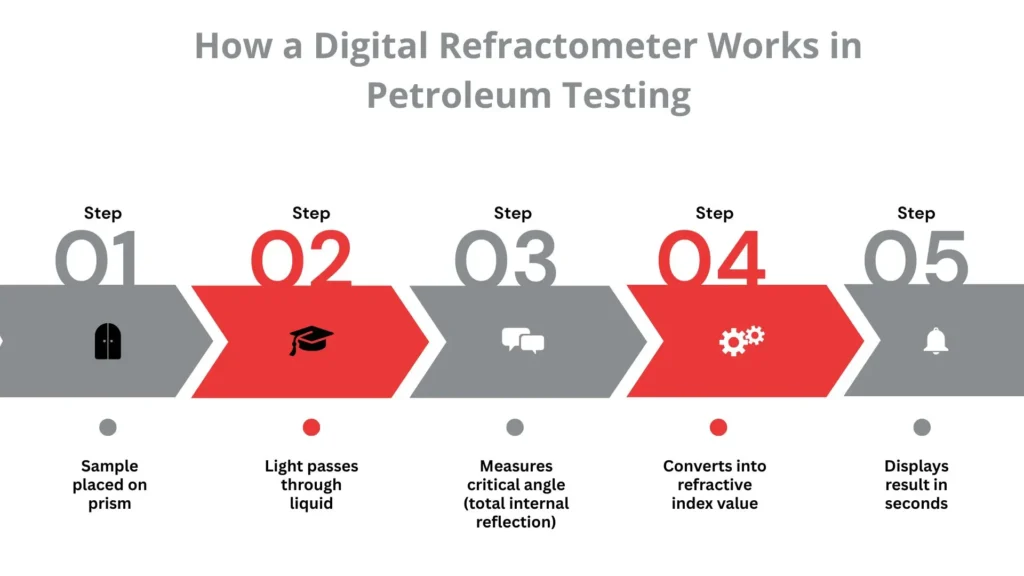
The operating principle behind a digital refractometer is based on total internal reflection of light. When a liquid sample is placed on the prism surface, light passes through it at a specific angle. The instrument detects the critical angle at which total internal reflection occurs and converts that into a refractive index value.
What separates a digital refractometer from a traditional Abbe refractometer or a handheld analog version is how it processes and displays this measurement. Digital instruments use a CCD or photodiode array to detect the light boundary automatically. The result appears as a precise numerical value on the screen, usually within seconds.
Most instruments used in petroleum labs also come with Automatic Temperature Compensation (ATC). Refractive index is sensitive to temperature, and in a busy lab environment where sample temperatures can vary, ATC ensures that the reading is corrected to a standard reference temperature, typically 20°C. This is particularly important when testing petroleum products because their optical properties can shift noticeably with even small temperature changes.
How to Calibrate a Digital Refractometer for Accurate Petroleum Testing
Before you measure anything, calibration is the step you cannot skip. An instrument that is not properly calibrated will give you readings that look precise but are actually misleading. In petroleum testing, that kind of error can have real consequences for product quality and customer safety.
Calibration of a digital refractometer is straightforward but must be done consistently.
Start by cleaning the prism surface with a lint free cloth or lens tissue. Even a thin residue from a previous sample can affect calibration accuracy.
Apply two or three drops of distilled water onto the prism. Distilled water has a known refractive index of 1.3330 at 20°C, which makes it the standard calibration reference for most instruments.
Close the sample cover if the instrument has one, and press the calibration or zero button. The instrument will take a reading and set its baseline.
Check the displayed value. It should read 1.3330 or 0.000 depending on the scale your instrument uses. If it does not, use the calibration adjustment function on the instrument to correct it.
For petroleum laboratory work, it is also good practice to use certified reference liquids with a known refractive index traceable to national standards. This gives you a second verification point beyond distilled water and is particularly recommended when your lab operates under NABL accreditation or ISO 17025 requirements.
Calibrate the instrument at the start of each working day and any time the instrument has been moved, dropped, or left unused for an extended period.
Step by Step Guide on How to Use Digital Refractometer in the Lab
Once your instrument is calibrated, using the instrument follows a consistent process. Here is how it is done correctly in a petroleum laboratory setting.
Step 1: Clean the Prism
Use a clean, lint free cloth or optical tissue to wipe the prism surface. If you are switching between samples, clean thoroughly to avoid cross contamination. For petroleum products that leave oily residues, use a small amount of appropriate solvent like isopropanol on the cloth, then wipe again with a dry cloth before the next sample.
Step 2: Prepare and Apply the Sample
Allow the sample to reach a stable temperature before testing. If the sample has just been collected from a high temperature process, let it cool to near room temperature first. Apply two to three drops of the liquid sample onto the prism using a dropper or glass rod. Avoid introducing air bubbles into the sample as this disrupts the light path and leads to inaccurate readings.
Step 3: Take the Reading
Press the measurement button and allow the instrument to process the reading. A quality instrument will display a stable value within a few seconds. If the reading fluctuates or the instrument shows an error, the prism may not be properly covered by the sample or there may be air bubbles present.
Step 4: Record and Verify
Note down the refractive index value along with the sample temperature shown on the display. Compare the reading against the specification for the product being tested. If the reading falls outside the acceptable range, repeat the test with a fresh sample before drawing any conclusions.
Step 5: Clean After Use
After every measurement, wipe the prism clean immediately. Petroleum products left on the prism surface can harden or leave deposits that are difficult to remove and can affect future readings.
Petroleum Laboratory Applications of a Digital Refractometer
The digital refractometer has a wider range of applications in petroleum testing than many labs initially realise.
Base Oil and Lubricant Quality Control
Refractive index is used to verify the quality and composition of base oils and finished lubricants. Each grade and type of base oil has a defined refractive index range, and any reading outside that range can indicate contamination or incorrect blending.
Fuel Adulteration Detection
One of the most practically important uses of this instrument in the petroleum sector is detecting adulteration. Mixing kerosene into diesel, or adding lower grade components to a premium product, changes the refractive index of the blend. While this is not the only tool needed for adulteration testing, it provides a fast and reliable first check that can flag samples for further investigation.
Cutting Fluids and Coolant Concentration
Metal cutting fluids and water based coolants used in industrial processes are often petroleum derived or contain petroleum additives. A digital refractometer is widely used to measure the concentration of these fluids quickly, ensuring they remain within the correct operating range.
Transformer and Hydraulic Oils
Transformer oils and hydraulic fluids are tested for refractive index as part of quality assessment and incoming inspection. Changes in refractive index over time can indicate oxidation or contamination, making it a useful parameter in condition monitoring programmes.
Common Mistakes to Avoid When Using a Digital Refractometer
Even with a good quality instrument, there are a few mistakes that regularly affect the accuracy of results in the lab.
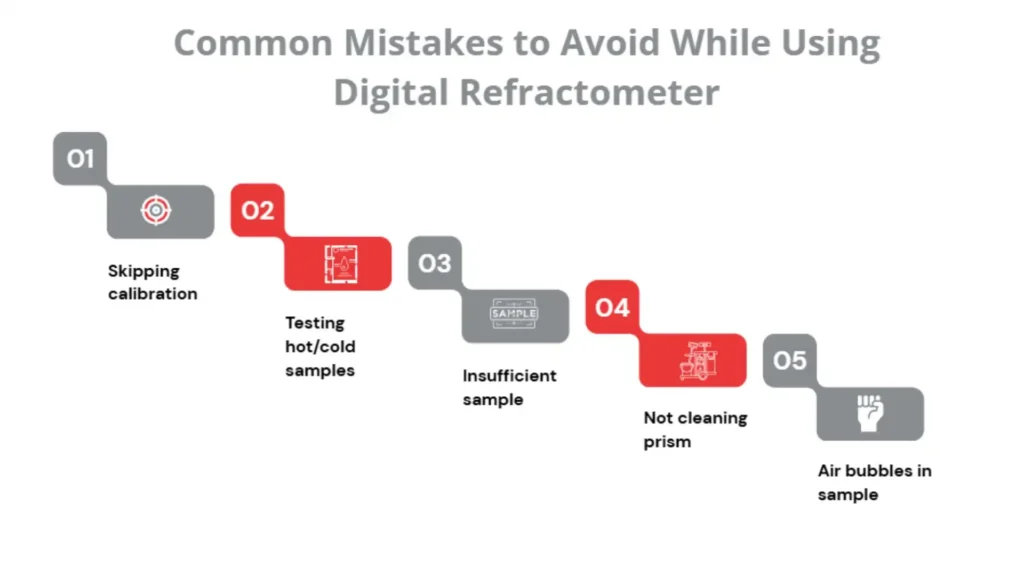
Skipping calibration before a testing session is the most common error. Calibration should be treated as a non negotiable step, not something done occasionally.
Testing samples that are too hot or too cold introduces temperature related errors even in instruments with ATC. ATC corrects for minor temperature variations but is not a substitute for testing at a temperature close to the reference standard.
Applying too little sample is another frequent problem. If the prism is not fully covered, the instrument cannot get a clean optical reading and the result will be unreliable.
Not cleaning the prism between samples leads to cross contamination. In petroleum testing, where the difference between a pass and a fail can come down to the third decimal place, a contaminated prism can completely invalidate a result.
Digital Refractometer vs Abbe Refractometer for Petroleum Labs
Both instruments measure refractive index, but they serve slightly different needs in a petroleum laboratory.
| Aspect | Digital Refractometer | Abbe Refractometer |
| Measurement | Measures refractive index | Measures refractive index |
| Main use | Routine quality control testing | Detailed analytical work and reference measurements |
| Accuracy | Very good for day-to-day testing | Very high accuracy |
| Ease of use | Easy to use | Requires more skill to operate |
| Reading method | Displays reading on screen | Reading is taken manually through an eyepiece |
| Speed | Faster | Slower |
| Operator dependence | Less dependent on operator skill | More dependent on operator skill |
| Best suited for | Petroleum QC labs, daily testing, multiple operators | Reference labs, calibration work, highest accuracy needs |
Applicable Standards for Refractive Index Testing in Petroleum Labs
Refractive index measurement in petroleum testing is governed by established standards that define the method, temperature reference, and acceptable precision.
ASTM D1218 covers the measurement of refractive index of transparent and light coloured liquids, including petroleum products. It specifies the test conditions and required accuracy for results to be considered valid.
ISO 5661 is the international standard for refractive index determination of petroleum products and is widely referenced in global supply chains.
IS 1448 (Part 78) is the relevant Indian Standard for refractive index testing of petroleum products.
When reporting refractive index values from a digital refractometer, always reference the standard used and the temperature at which the measurement was taken.
Frequently Asked Questions About Digital Refractometers
What refractive index range should a digital refractometer have for petroleum testing?
Most petroleum products fall within a refractive index range of 1.40 to 1.55. A digital refractometer with a range of 1.300 to 1.700 nD covers the full spectrum of petroleum and related products comfortably.
How often should the instrument be calibrated?
Calibrate at the start of every working day. If your lab handles a high volume of samples or operates under accreditation, calibrate with a certified reference liquid in addition to distilled water.
Can a digital refractometer detect fuel adulteration?
It can provide a reliable first indication of a problem. A refractive index reading outside the expected range for a product warrants further testing. It should be used alongside other test methods rather than as a standalone adulteration test.
Does temperature affect refractometer readings?
Yes. Although ATC compensates for temperature variation, samples should ideally be tested at or near 20°C for the most reliable results.
Conclusion
A digital refractometer is one of those instruments that earns its place in a petroleum laboratory very quickly. Once you understand how it works and follow a consistent process for calibration and sample handling, it becomes a reliable part of your daily testing workflow.
The key things to remember are simple. Always calibrate before you start testing. Keep the prism clean between every sample. Make sure your sample temperature is stable before taking a reading. And always report results with reference to the applicable standard and measurement temperature.
For petroleum labs in India and internationally, the digital refractometer is not just a convenience. It is a quality control tool that supports product integrity, regulatory compliance, and faster decision making on the lab floor. Whether you are testing base oils, checking for fuel adulteration, or monitoring coolant concentration, getting accurate refractive index data quickly makes a real difference to how your lab operates.
Digital Refractometers Available from Acute Instruments
Acute Instruments offers a range of digital refractometers suitable for petroleum labs.
DR 7400-P Digital Refractometer
A high-performance bench-top model with a range of nD 1.30000 to 1.72000 and accuracy of ±0.00002. It includes Peltier temperature control, touchscreen interface, and high data storage capacity, making it suitable for regulated environments.
DR 7300-P Digital Refractometer
Designed for high-volume labs, offering similar accuracy and range with fast measurement time and large data storage.
For reference-grade measurements, ABBE Refractometer AR4 and AR2008 are also available.
Contact our team to discuss which instrument best suits your petroleum testing requirements, request a brochure, or get a quote.