
Let me ask you something simple. If you had a drum of solvent sitting in your godown right now, would you know at what temperature it could catch fire?
Most people don’t think about it. And that’s exactly where accidents start.
The Pensky Martens Closed Cup Apparatus exists to answer that question with precision. It tells you the flash point of a liquid, which is the lowest temperature at which its vapours can ignite. One number. But it carries enormous weight when it comes to worker safety, legal compliance, and quality control.
This article covers everything you need to know about the Pensky Martens Closed Cup Apparatus. We’ll look at what it measures, how it works, which Indian industries use it, what standards it follows, and what to look for when buying one. Whether you’re managing a lab, handling safety compliance, or procuring equipment for your facility, this guide will give you clear, practical answers.
Key Takeaways About the Pensky Martens Closed Cup Apparatus
- The apparatus measures flash point, which is the temperature at which a liquid’s vapour first ignites on contact with a flame.
- It is used widely across Indian industries including petroleum, paints, chemicals, lubricants, and pharmaceuticals.
- It complies with ASTM D93, ISO 2719, and IS 1448 Part 21, which is the BIS standard applicable in India.
- Flash point data is mandatory for PESO approvals, NABL accreditation, and safe transport of hazardous goods in India.
- Acute Instruments supplies precision tested, standards compliant apparatus with full service support across India.
What Does a Pensky Martens Closed Cup Apparatus Measure?
It measures the flash point of a liquid. That’s the starting point of everything this instrument does.
Here’s a simple way to picture it. Think about a can of turpentine sitting near a gas burner in a paint shop. The liquid itself may not be burning. But it’s releasing vapours into the air above it. At some point, those vapours reach a concentration where a tiny spark or flame is all it takes. That moment, that exact temperature, is the flash point.
What makes the Pensky Martens method different from other flash point tests is the closed cup design. The sample sits inside a sealed cup with a lid on top. So the vapours can’t escape. They build up naturally above the liquid, just like they would inside a sealed storage container. This gives you a result that actually reflects real world conditions.
Open cup methods, by contrast, let vapours drift away. So they tend to give a higher flash point reading, which can actually underestimate the risk.
For petrol, the flash point is around 43 degrees Celsius below zero. That’s why it’s treated as highly flammable. Diesel falls somewhere between 52°C and 96°C depending on the grade. Even a relatively “safe” liquid like diesel needs to be tested and documented properly before it moves through the supply chain in India.
Why Is Flash Point Important for Safety and Quality Testing?
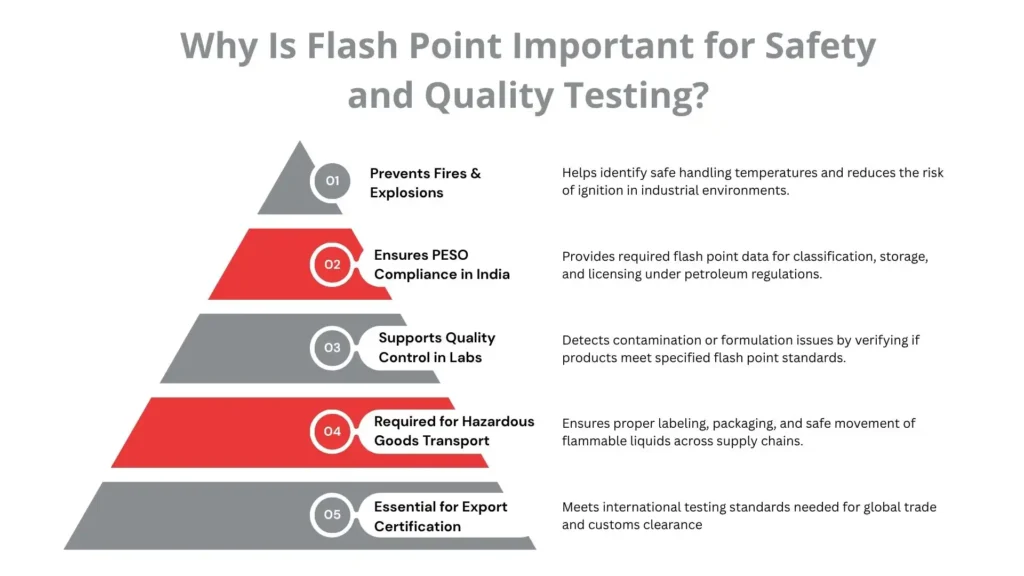
It’s more important than most people realise, especially in the Indian industrial context.
Fire and explosion prevention is the most obvious reason. India sees hundreds of industrial fire incidents every year, many of them linked to improper handling of flammable liquids. When workers and facility managers know the flash point of every substance on site, they can make informed decisions about storage temperatures, ventilation, and safety protocols.
Regulatory requirements in India are strict. The Petroleum Act, enforced through PESO, classifies petroleum products into categories based on their flash point. Class A liquids have a flash point below 23°C. Class B falls between 23°C and 65°C. Class C goes up to 93°C. These classifications determine how a liquid must be stored, handled, and transported. Get it wrong and you’re looking at licence cancellations, fines, or worse.
Quality control is another major reason. If your lubricant batch comes out with a flash point lower than the specification says it should be, that’s a sign something is contaminated or off in the formulation. The Pensky Martens apparatus catches that before the product reaches your customer.
And then there’s export compliance. If you’re shipping chemicals or petroleum products internationally, buyers and customs bodies will ask for flash point certificates. ASTM D93 and ISO 2719 are the standards they expect to see.
How Does a Pensky Martens Closed Cup Apparatus Work Step by Step?
The process is actually quite logical once you walk through it. Here’s how a typical test runs:
Step 1: Fill the test cup: You pour a measured amount of the liquid sample into the specimen cup, right up to the marked fill line. The sample should ideally be at room temperature when you start.
Step 2: Seal and heat: The lid goes on, and the apparatus begins heating the sample at a controlled rate. For lower flash point materials, the heating rate is typically around 1°C to 1.5°C per minute. For higher flash point substances it can go up to 5°C per minute. A stirrer keeps the temperature uniform throughout the sample.
Step 3: Vapours accumulate: Because the cup is sealed, the vapours coming off the heated liquid have nowhere to go. They collect in the space between the liquid surface and the lid. This is exactly the condition you’d find inside a storage tank or sealed drum.
Step 4: Apply the test flame: At fixed temperature intervals, usually every 1°C or 2°C, the operator opens a small shutter in the lid and dips a small test flame briefly into that vapour space.
Step 5: Watch for the flash: The instant a flash appears, that brief ignition of vapours, the operator notes the temperature. That’s your flash point.
Step 6: Correct for pressure: The result gets adjusted for atmospheric pressure if needed. Standard pressure is 101.3 kPa. Indian cities at higher altitudes or with variable weather may need this correction to be applied.
It sounds simple. And in skilled hands, it is. But the precision lies in controlling every variable, which is why instrument quality matters so much.
What Are the Main Components of a Pensky Martens Closed Cup Apparatus?
You don’t need to be an engineer to understand this. Here’s what the instrument is made of and why each part matters:
Test Cup: This is the metal cup that holds your sample. It’s typically designed to hold 70 mL and is machined to exact dimensions specified by the standard. Even small variations in the cup size affect your results.
Lid Assembly: The lid seals the cup during testing. It has openings for the thermometer, the stirrer shaft, and the test flame shutter. The integrity of this seal is critical. A poorly fitting lid means vapours escape, and your flash point reading will be too high.
Heating Bath: This surrounds the test cup and heats it evenly. Some models use an air bath, others use a liquid bath. The key is uniformity because hot spots in the sample will give you inconsistent results.
Stirrer: A small motor driven paddle inside the cup keeps the sample moving. Without it, the bottom of the sample heats faster than the top, and you end up testing a temperature gradient rather than a uniform sample.
Test Flame Applicator: This delivers the small ignition flame into the vapour space at the right moment. In older manual models, the operator controls this. In modern digital versions, it’s automated and timed precisely.
Temperature Sensor: Older apparatus used mercury thermometers. Modern instruments use digital sensors like PT100 probes, which are faster, more accurate, and eliminate the risk of mercury contamination in lab environments.
Control Panel: Automated models have a digital interface that sets and monitors the heating rate, controls the stirrer, triggers the test flame, and records the final result. This reduces operator error significantly and matters a lot in high volume testing environments.
Where Is the Pensky Martens Closed Cup Apparatus Used in Industry?
Across India, this apparatus shows up in more places than most people expect.
Petroleum refineries and fuel labs are the biggest users. Companies like Indian Oil, HPCL, BPCL, and Reliance run regular flash point tests on everything from crude oil fractions to finished diesel and aviation turbine fuel. It’s part of standard product quality checks before dispatch.
Paints and coatings manufacturers in cities like Hosur, Pune, and Ahmedabad test their solvent based products routinely. Flash point data determines how the product is labelled, how it’s transported under the Petroleum Act, and what fire safety measures the factory needs.
Chemical plants in industrial zones like Dahej, Ankleshwar, Vapi, and Ratnagiri handle solvents, process chemicals, and cleaning agents that require flash point documentation for plant safety and regulatory submissions to the State Pollution Control Board and PESO.
Lubricant manufacturers run flash point tests as part of finished product quality checks. If your engine oil flash point drops below spec, it could mean light end contamination, which compromises both performance and safety.
Pharmaceutical companies in Hyderabad’s pharma cluster, Ahmedabad’s GIDC estates, and Mumbai’s chemical corridors need flash point data for API solvents and excipients. It’s part of GMP documentation and Schedule M compliance under Indian drug manufacturing regulations.
Environmental and third party testing labs use the apparatus for waste characterisation, especially when classifying unknown mixed liquids under CPCB hazardous waste management rules.
And don’t forget logistics and freight companies handling hazardous cargo. Before loading a tanker or preparing a dangerous goods declaration for a shipment, accurate flash point data is non negotiable.
Which Standards Does the Pensky Martens Closed Cup Apparatus Follow and What Are Its Benefits?
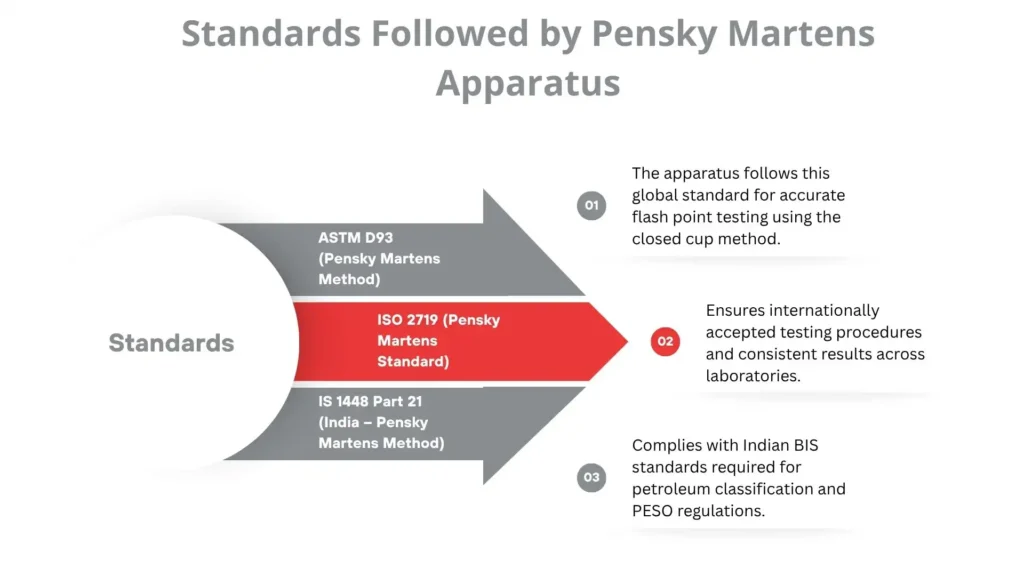
Standards That Matter in India
ASTM D93 is the most widely cited standard globally and is commonly used in Indian petroleum labs, export units, and third party testing facilities. It covers three test procedures for different types of samples.
ISO 2719 is the equivalent from the International Organisation for Standardisation. If you’re supplying to European buyers or working with MNC quality systems in India, this is the standard they’ll ask for.
IS 1448 Part 21 is the Bureau of Indian Standards specification for flash point testing of petroleum products using the Pensky Martens closed cup method. This is the standard that PESO references when classifying petroleum products. If your lab is NABL accredited or you’re applying for a petroleum storage licence in India, this is the standard that matters most locally.
All three standards define the same essential test conditions. Heating rate, stirrer speed, test flame size, pressure correction, and reporting format are all prescribed in detail. That’s what makes results from one lab comparable to results from another, whether you’re in Chennai or Rotterdam.
Why It’s Worth Using a Standards Compliant Apparatus
Honestly, a non compliant instrument might seem like a cost saving initially. But if your flash point data gets rejected by a regulator, challenged in a legal dispute, or flagged during an audit, the cost of that rejection will far exceed what you saved on the instrument.
Beyond compliance, a well designed, standards compliant apparatus simply gives you better data. Here’s what you get:
Accurate, reproducible results because the closed cup prevents vapour loss and the controlled heating gives you a stable, consistent test environment.
Wide measurement range covering flash points from near ambient temperature all the way up to 370°C, which covers almost everything tested in Indian labs.
Acceptance by Indian and international authorities including PESO, BIS, customs bodies, and export certification agencies.
Reduced testing risk because the enclosed design limits the chance of igniting the bulk sample during testing.
Automation options that cut down on human error and allow higher throughput in busy commercial labs.
Why Choose Acute Instruments for Your Pensky Martens Closed Cup Apparatus?
There’s no shortage of lab equipment suppliers in India. But not all of them understand what an Indian lab actually needs, and that’s where Acute Instruments makes a real difference.
Built to the Right Standards
Acute Instruments manufactures its Pensky Martens Closed Cup Apparatus to the exact specifications of ASTM D93, ISO 2719, and IS 1448 Part 21. Not roughly, not approximately. The dimensions, materials, and functional performance are engineered to meet the standard precisely. That matters when your results need to hold up in front of PESO, a NABL assessor, or an international buyer.
Results You Can Stand Behind
Nobody wants to repeat a test because their instrument gave inconsistent readings. Acute Instruments’ apparatus delivers reliable, low variance results batch after batch. Labs that have used their equipment report confidence in their data, and that confidence is earned, not claimed.
Support That Actually Shows Up
A lot of equipment suppliers sell you the instrument and disappear. Acute Instruments stays involved. They provide installation support, calibration services, hands on operator training, and ongoing maintenance. And because they operate within India, their service teams are actually reachable when you need them, not just on a support ticket that takes three days to resolve.
Practical Pricing for Indian Labs
You don’t need the most expensive model on the market to run accurate tests. Acute Instruments offers a range of options across manual, semi automated, and fully automated configurations. Whether you’re a small third party lab in Coimbatore or a quality control department at a large refinery in Gujarat, there’s a model that fits your throughput and your budget.
Frequently Asked Questions
What is the difference between a Pensky Martens closed cup test and an open cup flash point test?
The closed cup test traps vapours above the sample for a more realistic and accurate reading. The open cup test lets vapours escape, which typically gives a higher flash point result. In India, PESO and BIS require the closed cup method for most petroleum product classifications
What types of liquids are tested using the Pensky Martens Closed Cup Apparatus?
Diesel, lubricating oils, paints, solvents, hydraulic fluids, and pharmaceutical solvents are among the most common samples. Essentially, any flammable or combustible liquid that requires a flash point certificate for safety approvals or quality documentation in India can be tested using this apparatus.
How often does a Pensky Martens Closed Cup Apparatus need to be calibrated?
At minimum, once a year or after any significant repair or component replacement. NABL accredited labs and BIS certified facilities may need more frequent calibration depending on their internal quality protocols and testing volume
Is ASTM D93 accepted for flash point testing in India?
Yes. ASTM D93 is widely accepted in India by petroleum companies, export certification bodies, and quality labs. It is used alongside IS 1448 Part 21, which is the equivalent BIS standard referenced by PESO for petroleum product classification in India.
Is the Pensky Martens method recognised by PESO in India?
Yes. The Pensky Martens closed cup method is the recognised test procedure under India’s Petroleum Act for classifying petroleum products by flash point. Instruments complying with ASTM D93 and IS 1448 Part 21 are accepted for this purpose across PESO licensed facilities.
Final Thoughts on Choosing the Right Pensky Martens Closed Cup Apparatus
Here’s the bottom line. The Pensky Martens Closed Cup Apparatus is not a nice to have. If you’re working with flammable liquids in India, it’s a necessity. PESO requires it. BIS references it. NABL labs need it. And beyond all the compliance boxes, it’s simply the right thing to have when the safety of your workers and your facility depends on knowing exactly how your materials behave.
When you’re evaluating options, don’t just look at the price tag. Think about whether the instrument meets IS 1448, ASTM D93, and ISO 2719. Think about the temperature range you need. Think about how much automation your lab requires. And think about who’s going to support you six months after the purchase when something needs calibrating or a part needs replacing.
A good instrument from a reliable manufacturer is an investment that pays for itself quickly, in accurate data, in regulatory confidence, and in the peace of mind that comes from knowing your lab is doing things right.
Ready to find the right Pensky Martens Closed Cup Apparatus for your lab? Contact Acute Instruments today and our team will help you choose the best fit for your testing needs, budget, and compliance requirements.