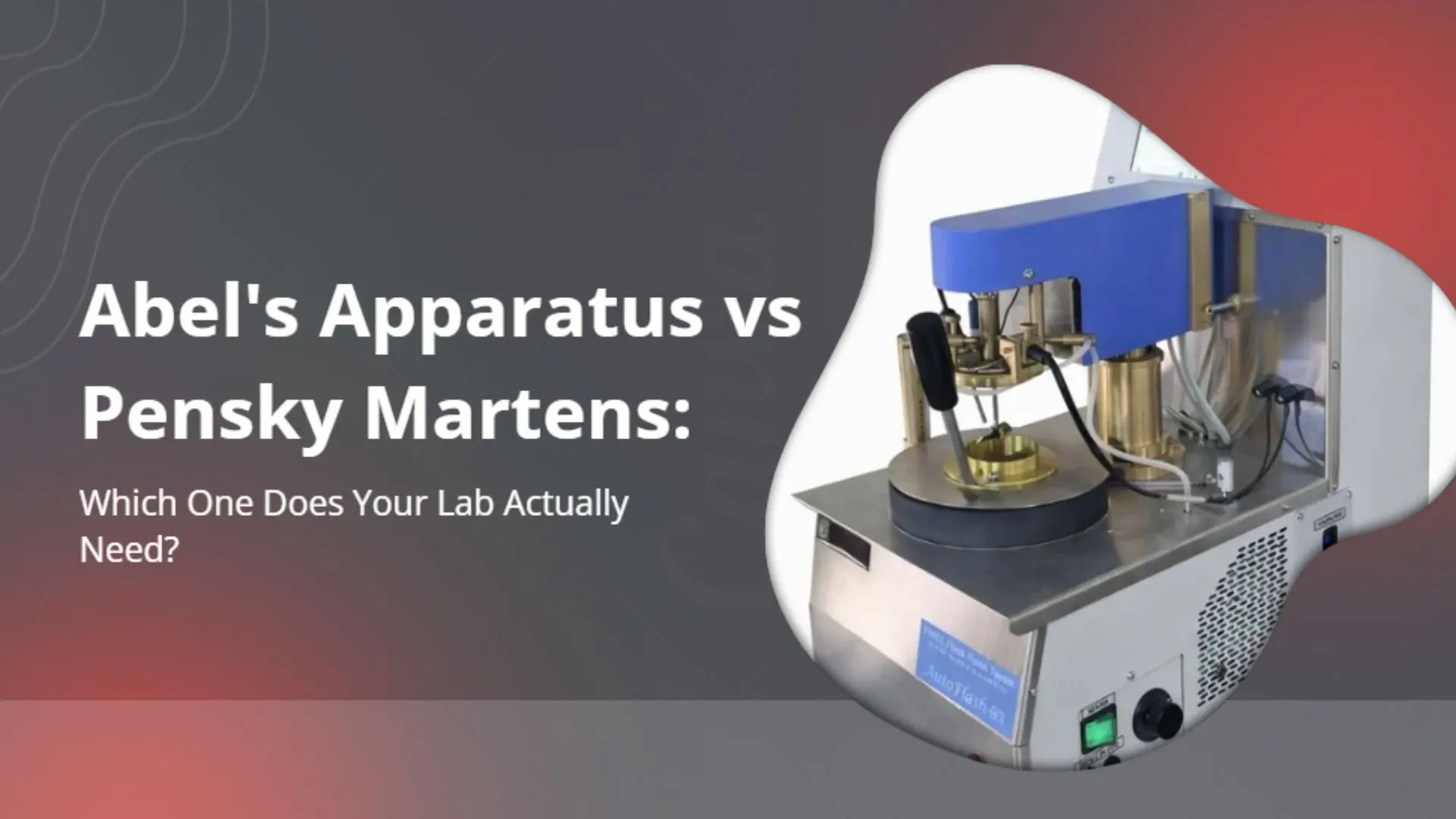
When a new consignment of solvent arrives at your facility and your quality team needs a flash point certificate before it goes into storage, the first question is straightforward: you need a closed cup flash point test. The second question is where many labs pause longer than they should: which apparatus do you use?
Both the Abel apparatus and the Pensky Martens are closed cup flash point testers. Both are recognised under IS 1448. Both are found in petroleum labs across India. But they are not interchangeable, they were not designed for the same materials, and selecting the wrong one can result in data that PESO or a NABL assessor will simply not accept.
This article breaks down the difference between Abel’s apparatus and Pensky Martens in plain terms, covering how each instrument works, what it was built to test, which Indian and international standards govern it, and how to decide which one belongs in your lab.
What the Two Instruments Have in Common
The confusion between these two instruments is understandable, because at a fundamental level, they operate on the same principle.
In both cases, the liquid sample sits inside a sealed cup. The cup is heated in a controlled, stepwise manner. At regular temperature intervals, a small test flame is briefly introduced into the vapour space above the liquid through a shutter in the lid. The first moment those vapours ignite, the temperature is recorded. That is the flash point.
The sealed cup design is what makes both of these closed cup methods, and it matters. Because the vapours cannot escape during the test, they accumulate above the liquid surface the same way they would inside a storage drum, a transport container, or a sealed tank. Open cup tests allow vapours to drift away, which typically gives a higher flash point reading and can underestimate the actual fire hazard.
Both instruments comply with IS 1448, India’s Bureau of Indian Standards framework for petroleum product testing, and both are used across industries including petroleum refining, paints and coatings, chemicals, solvents, and pharmaceuticals.
Beyond those shared principles, however, the two instruments diverge considerably in their design, operating range, and the materials they are intended to test.
If you want to understand closed cup testing in more depth, you can read our complete guide on closed cup flash point apparatus.
The Abel’s Closed Cup Apparatus: Designed for Low Flash Point, Volatile Materials
The Abel’s Closed Cup Apparatus specifically for liquids that vaporise readily at or near room temperature. Petrol, aviation spirit, naphtha, acetone, lacquers, paint thinners, and light chlorinated solvents are the primary candidates. These are not just flammable materials, they are volatile, meaning their vapours build up quickly even at ambient temperatures. Testing them accurately requires a method that is sensitive enough to detect flash points far below 100°C and gentle enough to handle the material safely during the test.
How the Abel Apparatus Heats the Sample
The defining feature of the Abel apparatus is its water bath heating system. The specimen cup sits within a water bath rather than being heated by a metallic block or direct air heater. This is not a coincidence of older design. A water bath delivers exceptionally even, uniform heat distribution with no local hot spots, and it caps the maximum achievable temperature naturally. For volatile, highly flammable samples, this prevents the risk of local overheating that could trigger a premature ignition before a meaningful flash point reading has been obtained.
The heating rate is slow and tightly controlled, typically around 1°C per minute in the temperature range near the expected flash point. The specimen cup holds approximately 16.5 mL of sample, a deliberately small volume that reduces the quantity of volatile material present during testing and keeps the procedure as safe as possible.
At fixed temperature intervals, a shutter in the lid opens briefly and the test flame is introduced into the vapour space. When a flash occurs, the temperature is noted as the flash point.
Temperature Range of the Abel Apparatus
The Abel apparatus is designed to measure flash points from approximately -30°C to +70°C. This covers the full working zone for Class A petroleum products under India’s Petroleum Act, which are defined as having a flash point below 23°C. Petrol, aviation spirit, and most light solvents fall squarely within this range.
Standards That Apply to the Abel Apparatus in India
- IS 1448 Part 20: The Bureau of Indian Standards method for flash point determination using the Abel apparatus. This is the standard PESO references when classifying Class A petroleum products, and the one your test data must cite for storage licence applications and handling approvals involving Class A materials.
- ASTM D56: The American Society for Testing and Materials standard, widely used in Indian export labs and quality systems aligned with international buyers.
- IP 170: The Institute of Petroleum method, referenced in labs with international affiliations particularly within UK-based quality frameworks.
- BS EN ISO 13736: The European standard for Abel closed cup flash point testing, applicable when supplying to EU markets or operating within a multinational quality management system.
The Pensky Martens Closed Cup Apparatus: Built for Heavier Petroleum Products at Higher Temperatures
Diesel fuel, lubricating oils, transformer oils, heating oils, hydraulic fluids, and cutback bitumen do not vaporise at ambient temperatures. These materials require significant heating before their vapours reach a concentration that can ignite. The Pensky Martens Closed Cup apparatus was designed specifically to test materials in this higher flash point range, and its construction reflects that purpose at every point.
How the Pensky Martens Heats the Sample
Rather than a water bath, the Pensky Martens uses an air bath or a metallic heating block surrounding the specimen cup. This allows the instrument to reach temperatures well above 100°C, and in some configurations up to 370°C, which is simply not achievable with a water bath.
The specimen cup is considerably larger, holding approximately 70 mL of sample. The greater volume gives more stable, consistent temperature conditions for viscous liquids that do not distribute heat the way thin, light solvents do. A motorised stirrer inside the cup compensates for the natural tendency of thick oils to develop temperature gradients, keeping the bulk sample at a uniform temperature throughout the test.
The heating rate is typically 5°C to 6°C per minute during the initial phase, reducing to around 1°C per minute as the temperature approaches the expected flash point. As with the Abel, the test flame is applied at regular intervals through the lid shutter. The first distinct ignition of vapours, not a sustained flame but the brief flash that signals the lower flammability limit, is recorded as the flash point.
Temperature Range of the Pensky Martens Apparatus
The Pensky Martens covers a flash point range from approximately 40°C up to 370°C. This makes it the appropriate instrument for diesel (which typically flashes between 52°C and 96°C depending on grade), lubricating oils, transformer oils, heavy fuel oils, and other petroleum fractions with flash points well above ambient temperature.
Standards That Apply to the Pensky Martens in India
- IS 1448 Part 21: The BIS standard for flash point testing using the Pensky Martens closed cup method. This is the primary standard PESO uses to classify Class B and Class C petroleum products, and the one your results need to reference for diesel, lubricants, and fuel oils.
- ASTM D93: The most widely used international standard for this method, referenced by Indian refineries, third party testing labs, and quality systems aligned with global petroleum industry requirements.
- ISO 2719: The ISO equivalent, required in labs supplying to European clients or operating under ISO-aligned quality frameworks.
- IP 34: The Institute of Petroleum method, frequently used in labs with UK affiliations or legacy quality systems referencing older British standards.
Side-by-Side: The Key Difference Between Abel’s Apparatus and Pensky Martens
| Parameter | Abel’s Apparatus | Pensky Martens Apparatus |
| Heating method | Water bath | Air bath / metallic block |
| Sample volume | ~16.5 mL | ~70 mL |
| Flash point range | -30°C to +70°C | ~40°C to 370°C |
| Target materials | Petrol, naphtha, solvents, thinners | Diesel, lubricants, fuel oils, transformer oils |
| Petroleum Act class | Class A (below 23°C) | Class B (23°C to 65°C) and Class C (65°C to 93°C) |
| Indian standard | IS 1448 Part 20 | IS 1448 Part 21 |
| International standard | ASTM D56, IP 170 | ASTM D93, ISO 2719, IP 34 |
| Stirrer | Not required | Motorised stirrer included |
Which Apparatus Does Your Lab Actually Need?
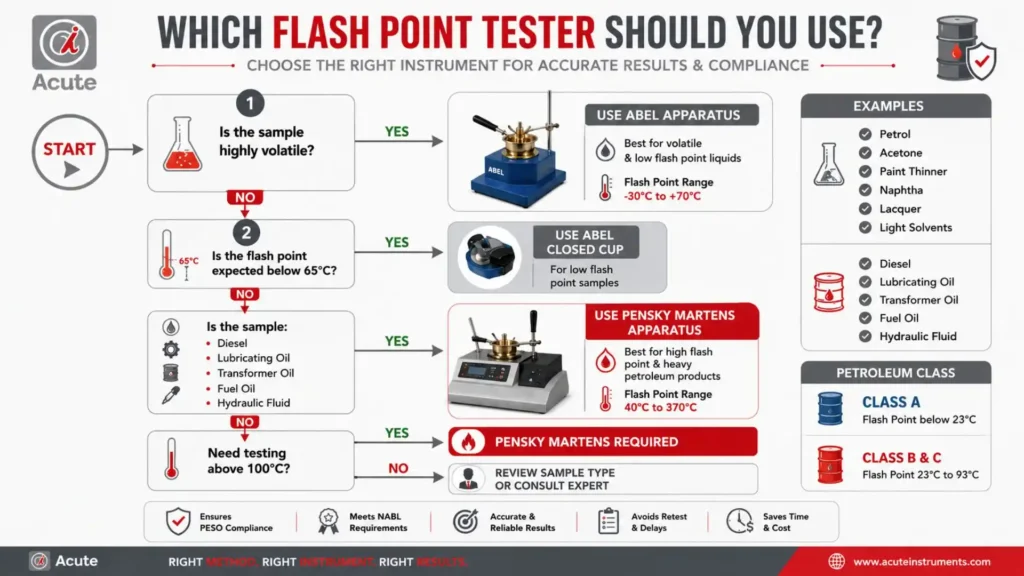
The answer depends entirely on what your lab tests, not on which instrument is more familiar or more commonly available.
If your lab primarily handles petrol, aviation spirit, acetone, lacquers, paint thinners, or light solvents with expected flash points below 65°C, the Abel apparatus is the correct choice. IS 1448 Part 20 and ASTM D56 are the standards that regulators and buyers expect for these materials, and both are built around the Abel method. The water bath heating and small sample volume are specifically suited to the volatility of these liquids.
If your lab tests diesel, lubricating oils, transformer oil, fuel oil, hydraulic fluids, or heavy process chemicals, the Pensky Martens is the appropriate instrument. Its temperature range, larger specimen cup, and motorised stirrer are designed for the physical properties of these materials. IS 1448 Part 21 and ASTM D93 are the standards your PESO licence, NABL accreditation documentation, and QC records will need to reference.
If your lab handles both categories, which is common in third party testing labs, commercial petroleum testing facilities, and large industrial QC departments, both instruments are necessary. No single apparatus covers the complete range of materials with the accuracy and standard compliance that each category requires.
A recurring issue in labs with limited equipment is the practice of running everything through the Pensky Martens because it is the more familiar instrument. When a sample has a flash point below 40°C, the Pensky Martens is outside its designed range for that measurement, and the results will not meet the precision requirements of IS 1448 Part 20. PESO will not classify a Class A product based on data generated from an instrument operating under the wrong standard.
Why Method Selection Matters for PESO, NABL, and Compliance in India
India’s Petroleum Act classifies petroleum products into three categories based on flash point, and PESO enforces these classifications strictly when issuing storage licences and handling approvals.
- Class A: Flash point below 23°C. Covers petrol, naphtha, and most light solvents. Tested using the Abel method under IS 1448 Part 20.
- Class B: Flash point between 23°C and 65°C. Covers kerosene, certain solvents, and some paint products. Tested using the Pensky Martens under IS 1448 Part 21.
- Class C: Flash point between 65°C and 93°C. Covers diesel, furnace oil, and certain lubricants. Also tested using the Pensky Martens under IS 1448 Part 21.
If a Class A product is tested on a Pensky Martens and submitted to PESO with a reference to IS 1448 Part 21, the result will be rejected because the cited standard does not correspond to the product classification. The test must then be repeated using the correct apparatus at a certified facility, adding both cost and time to the approval process.
NABL accreditation assessors apply similar scrutiny. Labs are expected to demonstrate that the correct test method was applied to each sample type, not simply that a flash point was measured. A non-conformance finding on method selection affects the lab’s accreditation scope and triggers corrective action requirements that can disrupt normal operations.
Frequently Asked Questions
Can the Pensky Martens apparatus be used to test petrol or light solvents?
Technically, the sample can be heated in the instrument, but the results at flash points below the instrument’s accurate operating range will not meet the precision requirements of the applicable standard. More critically, PESO and NABL will not accept data generated from the wrong method for Class A product classification. Petrol and light solvents require the Abel apparatus tested under IS 1448 Part 20 or ASTM D56.
Is the Abel apparatus less accurate than the Pensky Martens?
No. This is a common misconception. Within its intended temperature range, the Abel’s water bath heating is actually more precise for volatile samples because it eliminates local overheating and delivers a more uniform, controlled temperature rise. The accuracy of either instrument is a function of using it within its designed range, not of one method being inherently superior to the other.
What happens if flash point data from the wrong apparatus is submitted to PESO?
The submission will be rejected on the basis that the standard cited does not match the product classification being assessed. The test will need to be repeated at a certified lab using the correct apparatus, which adds cost and can significantly delay licence approval or renewal.
Are automated versions available for both apparatus types?
Yes. Both the Abel and Pensky Martens apparatus are available in semi-automated and fully automated configurations. Automated models reduce operator-dependent variability, apply the test flame with precise timing, and log results directly to the system. For labs with high daily testing volumes, the throughput difference between manual and automated configurations is considerable.
Does Acute Instruments supply both the Abel and Pensky Martens apparatus?
Yes. Acute Instruments manufactures and supplies both the Abel Closed Cup and the Pensky Martens Closed Cup apparatus, built to IS 1448, ASTM, and ISO specifications. Installation, calibration, operator training, and after-sales support are provided across India.
Conclusion
The difference between Abel’s apparatus and Pensky Martens goes beyond the design of the instrument itself. It is fundamentally about which materials each method was developed to test, which standards your regulators and buyers require, and whether the data your lab generates will hold up under scrutiny.
Both instruments are well-designed and reliable within their intended applications. Neither is a substitute for the other. Selecting the right apparatus is not a minor procurement consideration, it is a compliance requirement that directly affects whether your test data will be accepted by PESO, NABL, and the clients your lab serves.
If you are setting up a new lab or expanding the scope of your testing and need guidance on which instrument fits your sample types and compliance obligations, the team at Acute Instruments can help you identify the right configuration for your requirements.
Disclaimer: The regulatory classifications and standards mentioned in this article are for informational purposes only. For the most current and legally binding requirements, please refer to the official PESO website and the Bureau of Indian Standards.