
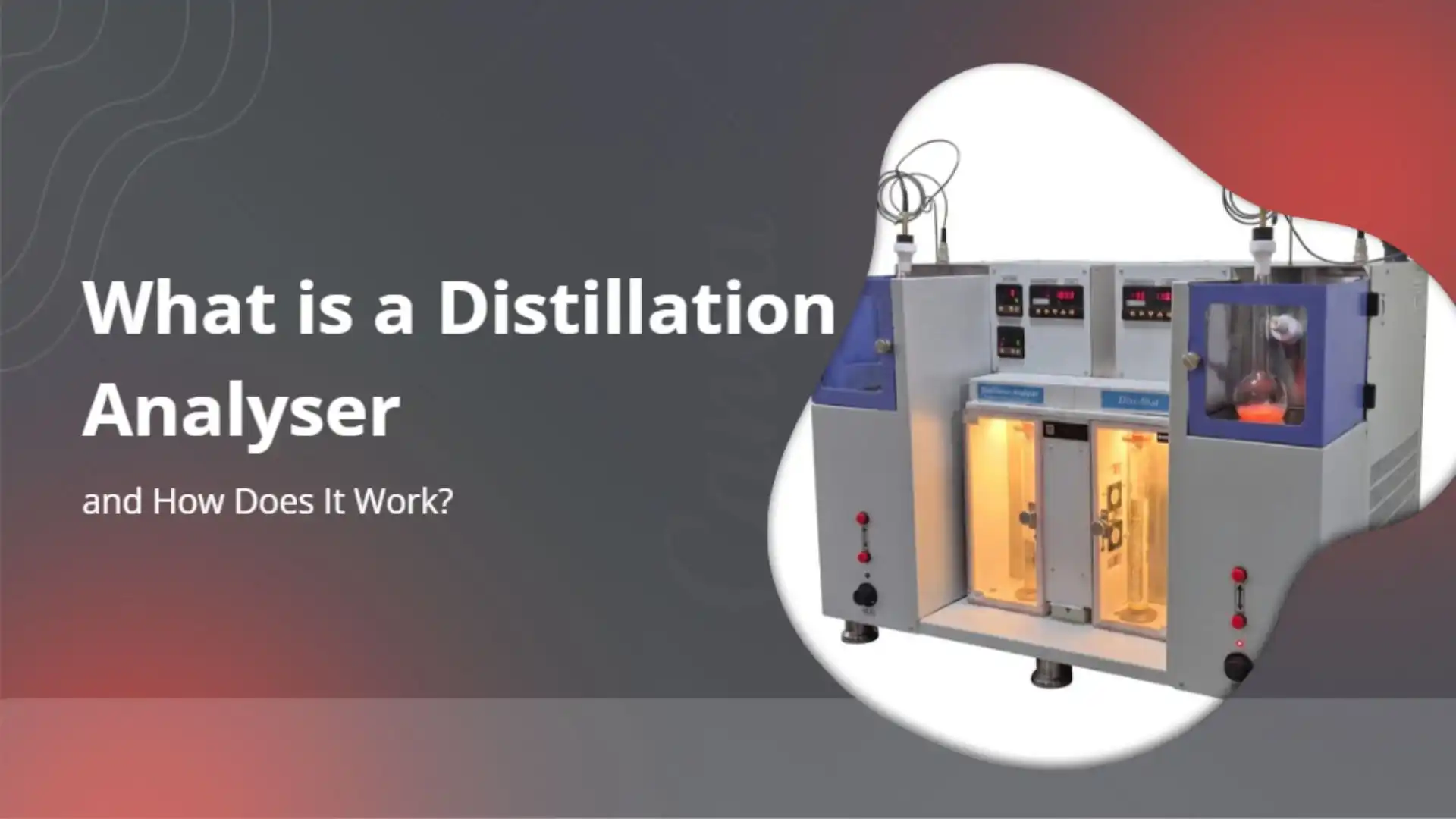
Petroleum products are defined, in large part, by their volatility. Petrol, diesel, kerosene, naphtha, and aviation turbine fuel each vaporise across distinct temperature ranges, and those ranges have direct consequences for how a product performs in service. The temperature at which lighter fractions boil off affects cold start behaviour in engines. The point at which the heaviest components vaporise determines whether residues accumulate in injectors over time. These are not marginal concerns. They sit at the centre of fuel quality assessment.
The distillation analyser is the instrument used to measure these characteristics with the precision that regulatory and commercial standards demand. For quality control laboratories, petroleum refineries, and testing facilities across India, it is among the most essential pieces of analytical equipment in operation.
This article explains what that test measures, how the instrument works, which configuration fits which type of operation, and what standards govern the process in India.
What Does a Distillation Analyser Actually Measure?
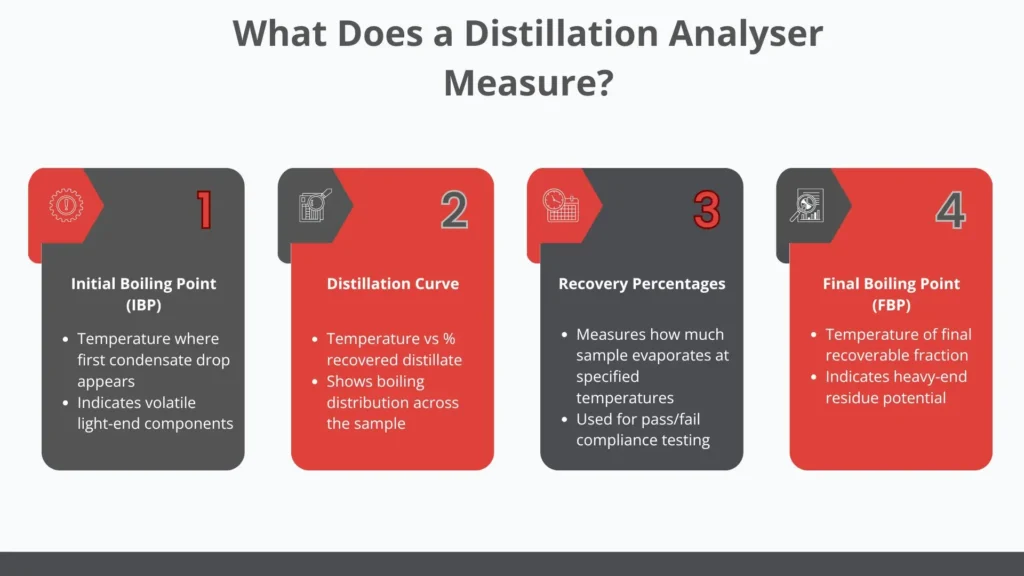
A distillation analyser records the temperatures at which successive fractions of a sample vaporise and condense, building a complete picture of the product’s boiling range. The test generates four categories of data:
- Initial Boiling Point (IBP): The temperature at which the first drop of condensate falls from the condenser, reflecting the concentration of the most volatile components in the sample.
- Distillation curve: Temperature plotted against cumulative percentage of sample recovered as distillate, showing how composition is distributed across the full boiling range.
- Recovery percentages at specified temperatures: Fuel quality standards prescribe what percentage must have distilled by defined temperature points. These values form the basis of pass or fail determinations in product certification.
- Final Boiling Point (FBP): The temperature at which the last measurable distillate is collected, indicating the heaviest components present and their residue formation potential.
A petrol batch with excessive heavy end components will perform poorly in cold conditions. Diesel whose end point exceeds the permitted limit carries a higher risk of injector fouling. The distillation analyser exists to identify these problems before the product leaves the facility.
How Does a Distillation Analyser Work?
The primary method for atmospheric distillation of petroleum products is ASTM D86. The Indian equivalent is IS 1448 Part 18, and the Institute of Petroleum method IP 123 follows the same procedure. All three are operationally equivalent.
A 100 mL sample is placed in a distillation flask fitted with a temperature sensor at the vapour outlet and connected to a condenser tube passing through a cooling bath. A graduated receiver cylinder collects distillate at the condenser outlet.
Heat is applied at a controlled rate. Lighter fractions vaporise first, travel into the condenser, cool back into liquid, and drip into the receiver. The temperature is recorded when the first drop falls, at every 10 mL of distillate collected, and at the end of the test. These readings produce the distillation curve and the recovery percentage calculations required by the applicable standard. The complete test takes between 30 and 60 minutes depending on sample type and instrument configuration.
Types of Distillation Analysers
Laboratories differ in testing volume, staffing structure, and compliance obligations. Distillation analysers are available in three configurations, each suited to a different operational profile.
Manual Distillation Analyser
In a manual unit, the technician participates actively throughout the test. Heating rate is adjusted by hand, temperatures are read from a calibrated thermometer, and distillate volumes are recorded manually at each interval. Every data point is the product of direct operator involvement.
This places considerable responsibility on the person conducting the test. Result accuracy depends on how consistently each step is executed across the full duration of the run. That said, a trained technician who follows the procedure carefully will produce data that is accurate, reproducible, and fully compliant with the applicable standard. The format has served petroleum testing laboratories reliably for decades.
Its limitation surfaces in specific circumstances: where the same experienced operator cannot be guaranteed for every run, where tests are conducted across shifts by personnel of varying experience levels, or where daily volumes are high enough that sustained attentiveness becomes a genuine constraint. In those conditions, variability tends to reflect the operator rather than the sample.
For low volume laboratories, field testing environments, and facilities requiring a dependable secondary instrument, a manual analyser is a practical and cost effective solution. Acute Instruments’ Dist 86M is manufactured to IS 1448 Part 18 and ASTM D86 specifications for these operational contexts.
Semi-Automated Distillation Analyser
A semi-automated unit transfers control of the most consequential test parameters to the instrument. Temperature control, heating rate management, and data recording at each interval are handled automatically. The technician prepares the sample, initiates the test, and monitors progress. The instrument manages execution.
The practical benefit is consistency. When heating rate is controlled by the instrument, deviations are prevented rather than corrected after the fact. When data is recorded automatically, timing inconsistencies and transcription errors that accumulate across a manually conducted test are eliminated. A technician running their first independent test will produce results considerably closer to those of an experienced colleague than would be possible on a manual unit.
This is of particular value in laboratories where testing responsibilities are shared across multiple personnel, where shift patterns mean different technicians handle the same product types on different days, or where client requirements are placing increased pressure on reproducibility.
Acute Instruments offers two instruments in this category. The Semi Automated Distillation Analyser 86S handles single samples and suits most moderate volume quality control laboratories. The Semi Automated Twin Distillation Analyser 86T operates as a twin configuration, processing two samples simultaneously for facilities where sequential testing constrains throughput.
Fully Automated Distillation Analyser
A fully automated analyser requires minimal operator involvement. The technician loads the sample, initiates the run, and returns to a completed report. Temperature control, heating rate, volume measurement, data logging, curve generation, and report output are all managed by the instrument without intervention.
For high volume laboratories processing dozens of samples daily, this level of automation is not incidental. It is the only configuration that makes such workloads manageable without compromising turnaround times or result quality. It also produces the traceable, time stamped records that NABL accreditation assessors expect during audits, as a standard output of every run rather than a supplementary documentation effort.
Acute Instruments’ Automated Distillation Analysers AutoDist 86 is available in two versions, ver 2.0 and ver 3.0, both built to ASTM D86 and IS 1448 Part 18, with complete data logging and report generation.
Where is a Distillation Analyser Used in India?
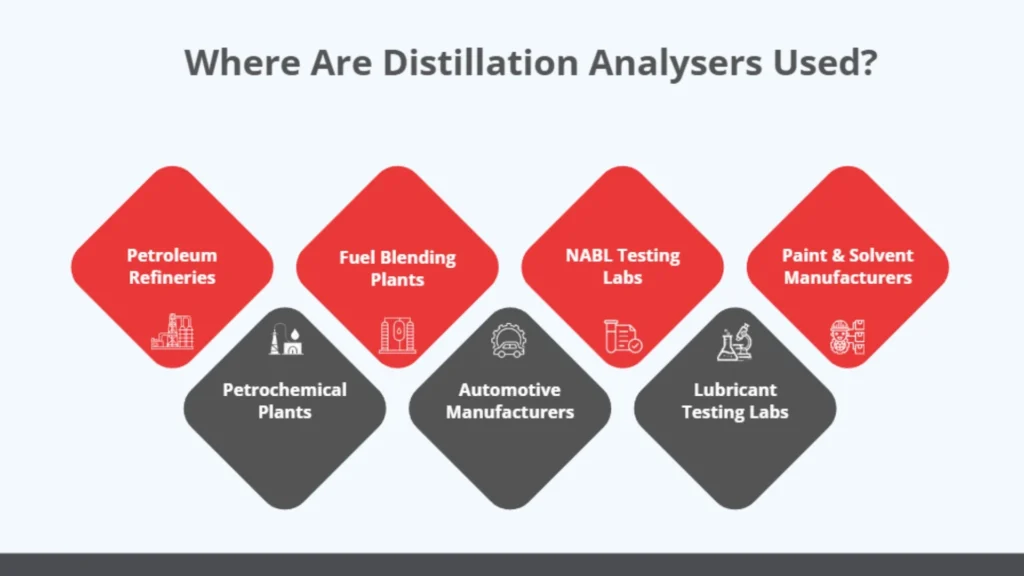
Distillation testing is a standard requirement across several sectors:
- Petroleum refineries and fuel blending units: Indian Oil, HPCL, BPCL, and private refining operations test every batch of petrol, diesel, ATF, and kerosene against distillation specifications before dispatch.
- Third party testing laboratories: NABL accredited labs run ASTM D86 and IS 1448 Part 18 on behalf of fuel suppliers, chemical manufacturers, and for regulatory submissions.
- Paints and solvent manufacturers: Facilities across Gujarat, Maharashtra, and Tamil Nadu use distillation testing to confirm solvent blends and thinners meet product specifications.
- Petrochemical plants: Distillation data supports process stream monitoring and quality verification at multiple production stages.
- Automotive and lubricant manufacturers: Used for incoming material checks on base oils and fuels, and for finished product release testing.
Standards Your Distillation Analyser Must Follow in India
Three standards govern atmospheric distillation testing in India:
IS 1448 Part 18 is the Bureau of Indian Standards method and the reference standard for NABL accreditation and domestic regulatory compliance.
ASTM D86 is the globally dominant method, cited routinely by Indian refineries and export facing laboratories.
IP 123 is the Institute of Petroleum method, used in laboratories aligned with UK and European industry frameworks.
The core test procedure is consistent across all three. Differences exist in acceptance criteria and reporting formats for specific product types. Confirming which standard applies to your regulatory, accreditation, or commercial context before instrument selection is an important preliminary step.
Which Distillation Analyser is Right for Your Lab?
Three questions determine the answer: How many tests does your lab run daily? What level of result consistency do you need? What is your budget?
Low volume labs with experienced staff and tighter budgets are well served by a manual unit. It meets the same standards as automated equipment when operated correctly.
Labs with moderate volumes and mixed staffing levels need a semi-automated unit. The twin configuration makes sense if parallel sample runs are a regular occurrence.
High volume labs, multi-shift operations, and labs with NABL documentation requirements need a fully automated system. The reduction in per-test operator time and the improvement in cross-operator consistency justify the investment quickly at scale.
One more thing worth factoring in: a lab running ten tests a day today but expecting significant growth over the next two to three years is probably better off buying ahead of that growth than replacing equipment when it arrives.
Frequently Asked Questions
What is the difference between atmospheric and vacuum distillation analysers?
Atmospheric distillation under ASTM D86 and IS 1448 Part 18 covers products like petrol, diesel, kerosene, and naphtha, which can be distilled at ambient pressure without decomposing. Vacuum distillation handles heavier products like residual fuel oils and lubricant base stocks, which would decompose if heated to their boiling points at atmospheric pressure. The two methods require different instruments.
How long does a distillation test take?
Typically 30 to 60 minutes. Automated systems generally run faster and require less technician time than manual units.
Does a distillation analyser need regular calibration?
Yes. The temperature sensor, heating system, and condenser all require calibration at defined intervals to stay within the tolerances the standard specifies. NABL accredited labs maintain a documented calibration schedule as part of their quality management requirements.
Can one atmospheric distillation analyser cover all petroleum products?
For products tested under ASTM D86 and IS 1448 Part 18, yes: petrol, diesel, ATF, kerosene, and naphtha are all covered. Heavier products requiring vacuum distillation need a separate instrument.
Does Acute Instruments provide after sales support?
Yes. Acute Instruments supplies manual, semi automated, twin, and fully automated distillation analysers with installation, calibration, operator training, and ongoing maintenance support across India.
Conclusion
The distillation analyser does one job. But that job sits underneath a long chain of decisions: product release, batch certification, regulatory classification, export compliance. When the data is wrong, or generated under the wrong standard, those decisions go wrong with it.
The instrument needs to match the testing volume. The standard needs to match what regulators and buyers require. Getting both right from the start saves a significant amount of trouble later.
To find the right configuration for your lab, contact the Acute Instruments team with your testing volume, sample types, and applicable standards. We will give you the best solution as per your needs.
Disclaimer: Standards and regulatory references in this article are for informational purposes only. For current and legally binding requirements, refer to the official PESO website and the Bureau of Indian Standards.